Showing posts with label risk. Show all posts

Monday, August 20, 2018

Pacific Risk Management Conference: Relevance for Cultural Institutions


When a climate-driven flood, storm, or fire roars into your community, nearly everyone is affected. Pre-planning a response helps anyone or anything survive, recover from, and then thrive after the event. That's called resilience.

With so much more risk and damage around us, everyone will have to help, not just the first-responders, the waste haulers, and the construction crews.

Last week I attended the Pacific Risk Management 'Ohana (family/group) known as PRiMO to find connections among cultural institutions sector and the risk and disaster management sector. There is so much room for zoos, aquariums, museums of all kinds to work with our communities to help manage the increasingly frequent crises. I didn't find much happening, yet, but I did find terrific willingness among NOAA scientists, emergency communications specialists, community managers, and product developers to work with the cultural sector. They don't like disasters any more than we do! They too want to help the public understand the science of climate change, plan better for themselves, and make changes that will reduce risk and increase resilience.

So, if you had to deal with a present or future natural disaster in your community, what would your museum, zoo, garden or historic site do to help? If your community were in recovery mode, what could you do?

Short term: Could

  • your site be an accessible gathering spaces for preparation planning and staging, for professionals to host at-risk populations, and to provide services or staging during recovery?
  • you allow your empty parking lots be the staging site for power company equipment or emergency communication vehicles? 


    Post-disaster: Could 
    • your staff collect stories and oral histories from the community, then plan to share the stories of resilience and recovery in your community while memorializing losses and achievements?
    • your collections provide the information for restoring what has been lost?
    • your zoo and aquarium plan to care for a certain number of injured animals, and plan to relocate others suitably?

      NOAA has a great resource Digital Coast with instructions to 3-D print your own coral polyp modules
      You can made them sensitive to a warming ocean and watch them bleach!


      Long term: Could 


      • your aquarium be part of the process of educating people to protect coral reefs while rebuilding a living, resilient coral reef to protect your shores against rising seas and storm surges?
      • your historical records help explore potential impacts and better solutions for the future?
      • you educate the public about the science of safe drinking water and how to protect themselves after an event...maybe explain how MadiDrops work...
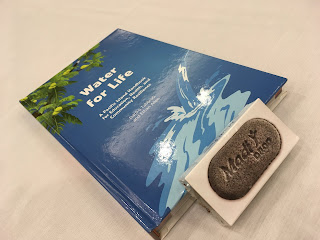


        https://www.madidrop.com/how-it-works/


      There's no limit the the relevant topics your museum, garden, aquarium, zoo or historic site can interpret. And there is so much your physical plant can provide to support the resilience effort.

      Please join the disaster planning conversations in your community. Help each other!

      Thursday, June 9, 2011

      AAM 2011 Session: Climate Change & Collective Action

      I have a tendency to attend any presentation on any topic by either Wayne LaBar or Emlyn Koster, both of Liberty Science Center, NJ, but this time they were really speaking my language - museums and their role in increasing human practices of environmental sustainability.

      Wayne and Emlyn are part of a mostly-Australian dialogue on how museums can collaborate to address climate change...how museums can help humans navigate the Anthropocene (see Wikipedia...new, unofficial term for the geologic age where climate is changed by human activity...see also Curt Stager with Tom Ashbrook and Bill McKibben March 24, 2011 interview. The project is Hot Science Global Citizens and it's an Australian Research Council Linkages Project. Wayne and Emlyn's presentation was sort of  'news from the field' as they reviewed the project's early-stage exploration of museum interventions, intersection of science and humanities, and responsibilities of citizens and the media. 

      Two parts stood out - Emlyn's discussion about why tackling climate change is so difficult for the field (with me loving that we agreed on many points, but I also learned a good bit); and Wayne's discussion about how museums must work to address the realities of public response to climate change understanding.
      Emlyn listed museums' structural disinclination to address climate change meaningfully. For the most part, museums still tend to:
      • focus on collections
      • rely on exhibits primarily
      • are slow to collaborate deeply and meaningfully
      • are poor at integrating past, present and future
      • their funders are cautious
      • museums tend to avoid the risk of controversy
      • museum schools, which might have tackled this topic mightily, have not been a widespread success
      • grants tend to support the status quo, not innovation
      • and museums are rarely visionary and do not take global leadership positions
      Wayne pointed out that "Climate change is no longer a science event, but a cultural change and it won't be solved by science policy." And he tackled the question of "why are people slow to change in response to climate change?"  The collaborative project discussions have articulated two critical disconnects - one of time and risk, and one of science and emotion. 

      First:  Education about climate change is scientific; response to climate change (perception of personal risk exposure followed by changes in behavior) is emotional.  Water and oil. 

      Second:  Since the risk of loss or injury due to climate change has an uneven and unpredictable timeline for each human perceiving it (will rising sea level affect me anytime soon or in a way I can see? Did a hurricane just him my house?), the debate about when and how much change there will be becomes a distraction that leads to a stalemate.

      So Liberty Science Center, instead of doing an exhibit on climate change, much they way they might do an exhibit on skyscrapers or on human health, has chosen to educate about sustainability across all exhibit platforms. It's not a science fact to be learned in a few discrete lessons, but a cultural issue that must seep into human processes from many, many sources.

      As a field I believe we should work hard to address the science/emotion and time/risk factors, but let's also use our position as educators, collaborators, and authorities to emphasize positive aspects of environmental sustainability: cost savings, resource conservation, and livable communities, so that we don't lose our audience.     

      I'm delighted to be introduced to the Hot Science Global Citizens Project and will follow their further adventures.